Tag Archives: sysadmin

Mr. DNS: Free DNS and Network Diagnostic Tools for Sysadmins and Email Teams

Mr. DNS is a free collection of DNS and network diagnostic tools built for sysadmins, email administrators, and infrastructure teams. The site has been around for years, went offline for a while, and recently relaunched with an expanded tool set. Everything runs in the browser with no account required. If you work with DNS records, mail servers, or IP reputation, there is something here you will use regularly.
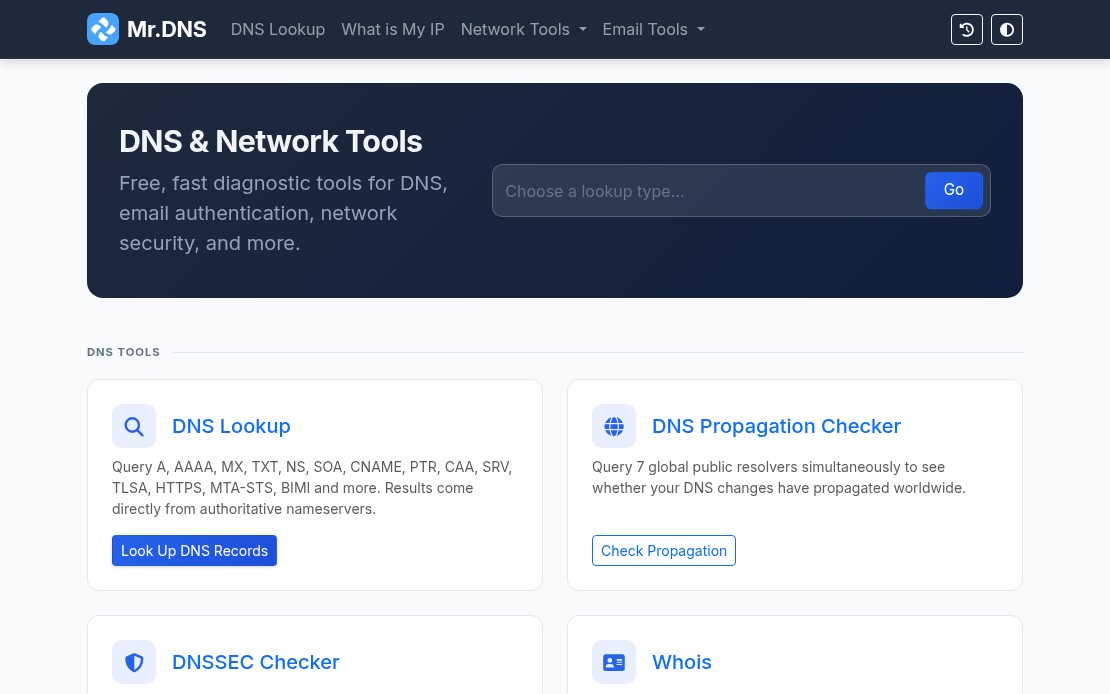
Mr. DNS homepage showing DNS and network diagnostic tools

DNS Tools

The DNS lookup tool handles all common record types: A, AAAA, MX, TXT, NS, SOA, CNAME, PTR, CAA, SRV, TLSA, HTTPS, MTA-STS, and BIMI. Results include TTL, geolocation data for nameservers, and flag icons for quick visual scanning.

The DNS propagation checker queries seven global resolvers simultaneously: Cloudflare, Google, Quad9, OpenDNS, AdGuard, NextDNS, and DNS.SB. Useful when you have just made a DNS change and need to see where it has landed without waiting or querying each resolver manually.

The DNSSEC checker validates the full chain of trust: DS records, DNSKEY records, RRSIG presence, and expiry. Good for confirming a DNSSEC deployment before and after changes.

Email Tools

The email tools are where Mr. DNS gets most of its daily use. The email health checker runs a combined SPF and DMARC evaluation and returns a letter grade (A through F) for your domain. One URL, one result, easy to share with a client or manager who needs a status report.
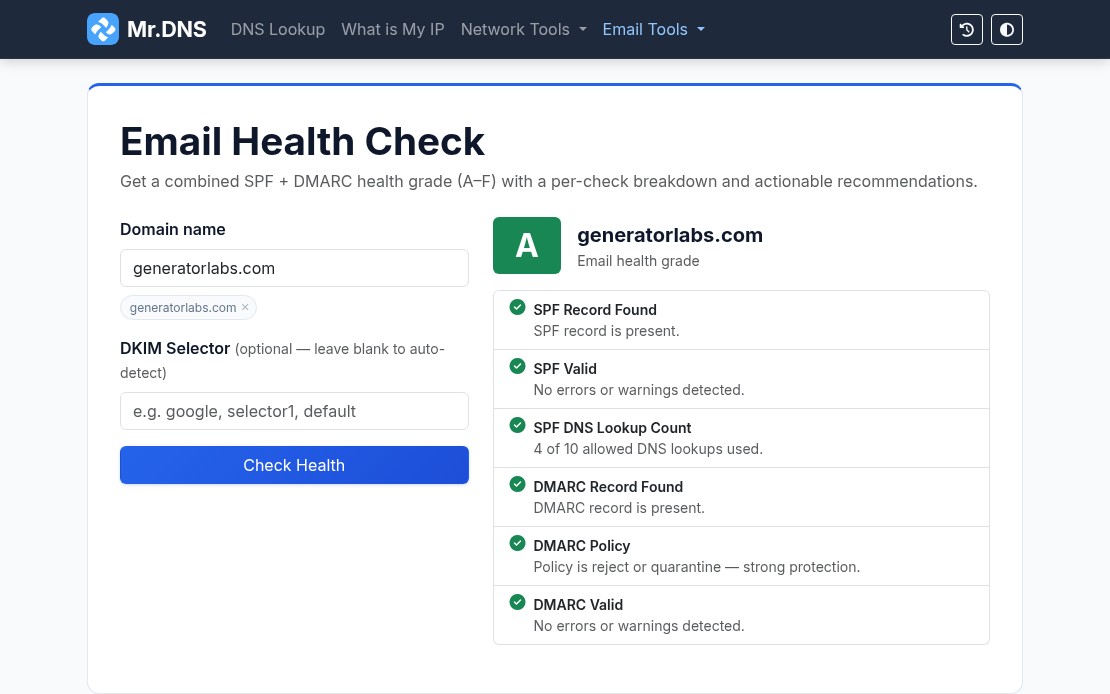
Mr. DNS email health checker showing an A grade for generatorlabs.com

Individual checkers are also available for SPF, DMARC, and DKIM when you need to dig into a specific record. The email header analyzer parses raw RFC 2822 headers and maps the full relay chain with per-hop timing and authentication results, useful for tracing a delivery failure or diagnosing a spam classification issue.

For teams managing outbound mail infrastructure, the MTA-STS checker validates DNS records and policy files, and the BIMI checker verifies SVG logos and VMC certificates for domains using brand indicators in supported mail clients.

Blacklist Checker

The blacklist checker queries your IP or domain against 15+ major RBLs and returns results in seconds. It is a solid first step when a client reports deliverability problems or when you are onboarding a new IP range and want a quick baseline.

For teams that need ongoing coverage rather than one-off checks, blacklist monitoring from Generator Labs runs continuous checks against hundreds of data sources and sends immediate alerts when a listing is detected. The free tier covers one host with no credit card required.

SSL and Network Tools

The SSL certificate checker inspects certificate details, expiry dates, SANs, issuer chain, and key type for any domain. Useful for a quick manual check before or after a certificate renewal.

For automated tracking across many domains, certificate monitoring from Generator Labs handles the ongoing work: scheduled checks, configurable expiry alert thresholds, and multi-channel notifications before anything expires.

Other network tools include ping, traceroute, port checker, HTTP headers inspector, HTTP/2 and HTTP/3 checker, and a what is my IP tool that detects both IPv4 and IPv6 with geolocation and ASN data.

Generators

Mr. DNS includes generators for SPF records and DMARC records for teams setting up email authentication from scratch. Both walk through the options and output a ready-to-paste DNS record.

Bottom Line

Mr. DNS covers the diagnostic side of DNS and email infrastructure without requiring an account or payment. For the monitoring side, Generator Labs provides continuous blacklist monitoring and certificate monitoring with alerting, picking up where the one-shot tools leave off. Both are worth bookmarking if you manage any kind of mail or DNS infrastructure.
Generator Labs: Blacklist and Certificate Monitoring for Email and Infrastructure Teams

Generator Labs provides infrastructure monitoring for teams that need to stay ahead of two specific problems: IP and domain blacklistings that kill email deliverability, and SSL certificates that expire without warning. Both products run in the same portal, so you manage everything in one place.

Blacklist Monitoring

Blacklist monitoring runs continuous checks of your IPv4 addresses, IPv6 addresses, and domains against hundreds of RBL and URIBL data sources. The moment a listing is detected, alerts go out through whatever channels you have configured: email, SMS, Slack, Discord, PagerDuty, or webhooks.

Coverage is the differentiator. Free one-shot tools check a handful of the major lists. Generator Labs checks well over a hundred data sources on a schedule, including 30+ premium sources on Enterprise and Ultimate plans that free tools do not cover. You get notified when something changes; you are not logging in to run a manual check.

Other features worth knowing:

Full IPv6 support. IPv4 and IPv6 addresses are both monitored across all plans. As more mail infrastructure goes dual-stack, IPv6 blacklisting is a real and growing issue that most monitoring tools still treat as secondary.

Shareable public reports. Every monitored host gets a public report URL you can hand to a client, ISP, or manager without giving anyone portal access.

REST API. Full programmatic access to monitoring data and controls, with client libraries for PHP, Node.js, and Python.

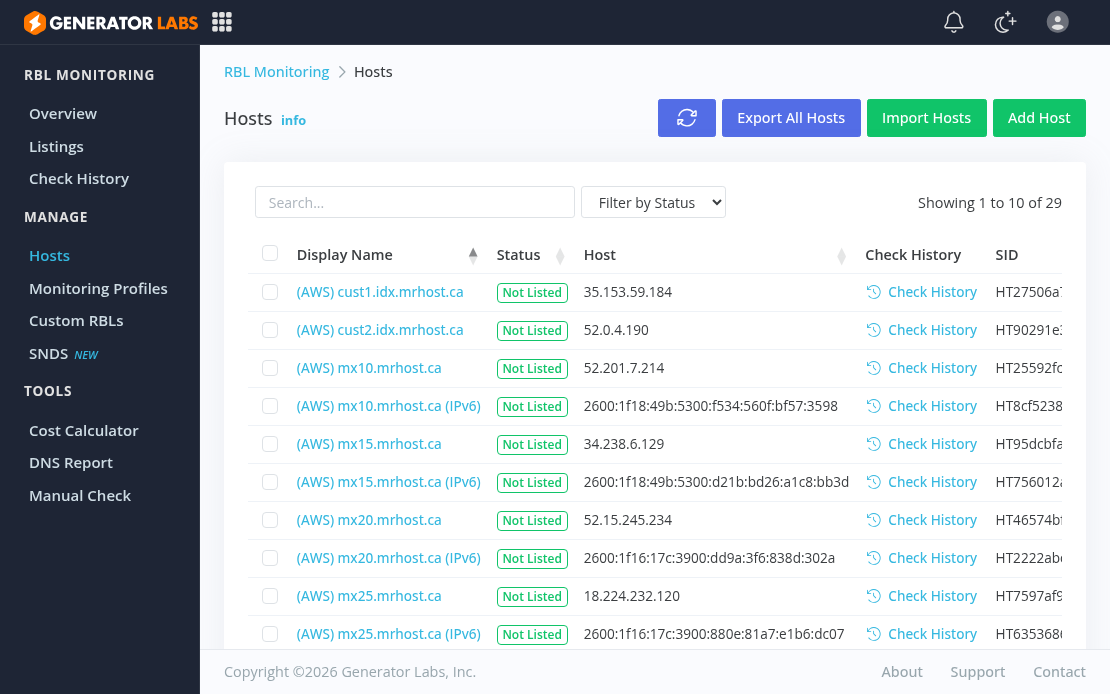
Generator Labs RBL Monitoring hosts list

Blacklist Monitoring Pricing

  • Free: 1 host, 48-hour check interval, 100+ data sources. Free forever, no credit card required.
  • Professional: $8/month for 20 hosts at 24-hour intervals.
  • Enterprise: $16/month for 50 hosts at 12-hour intervals, premium data sources, custom run times.
  • Ultimate: $0.005 per check, unlimited hosts, custom intervals, all premium sources.

The Ultimate pay-per-check plan scales cleanly for larger deployments. Running 50 hosts daily against 150 data sources works out to roughly $11/month.

Certificate Monitoring

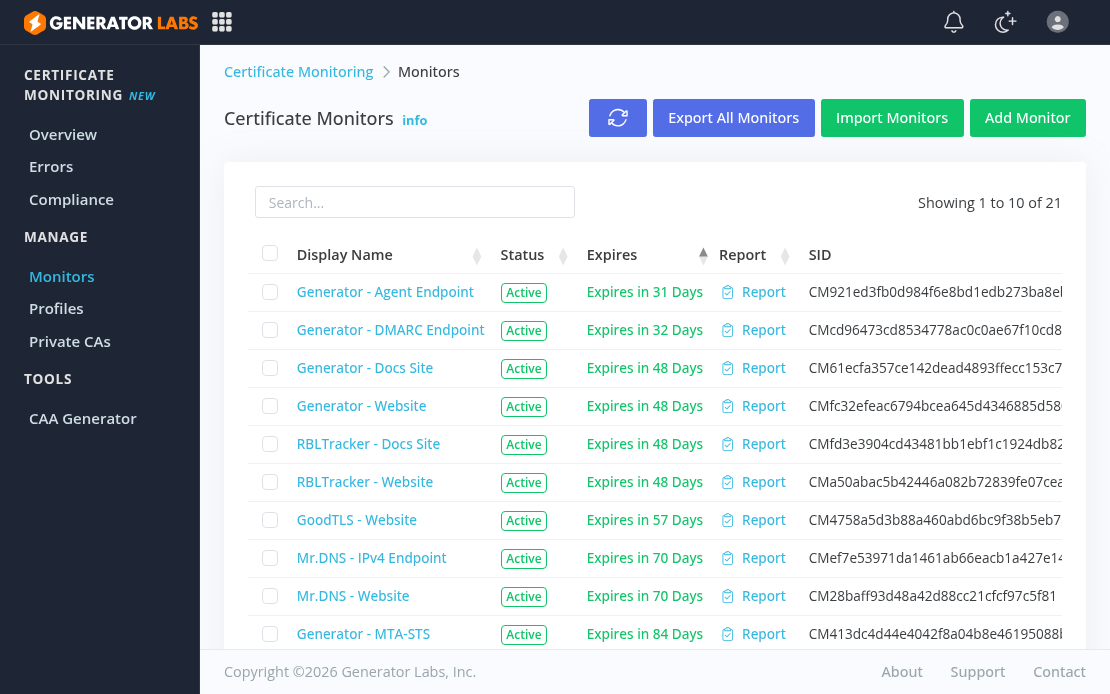
Certificate monitoring tracks SSL/TLS certificate expirations across your domains and sends alerts before anything expires. Add your domains, set alert thresholds, and the service runs automatically from there.

Both publicly-trusted and private or internal CA certificates are supported, which matters for teams running internal infrastructure that does not go through a public CA. Certificate expiry causes outages that are entirely preventable; automated monitoring removes the spreadsheet tracking and calendar reminders that most teams fall back on.

Generator Labs Certificate Monitoring monitors list

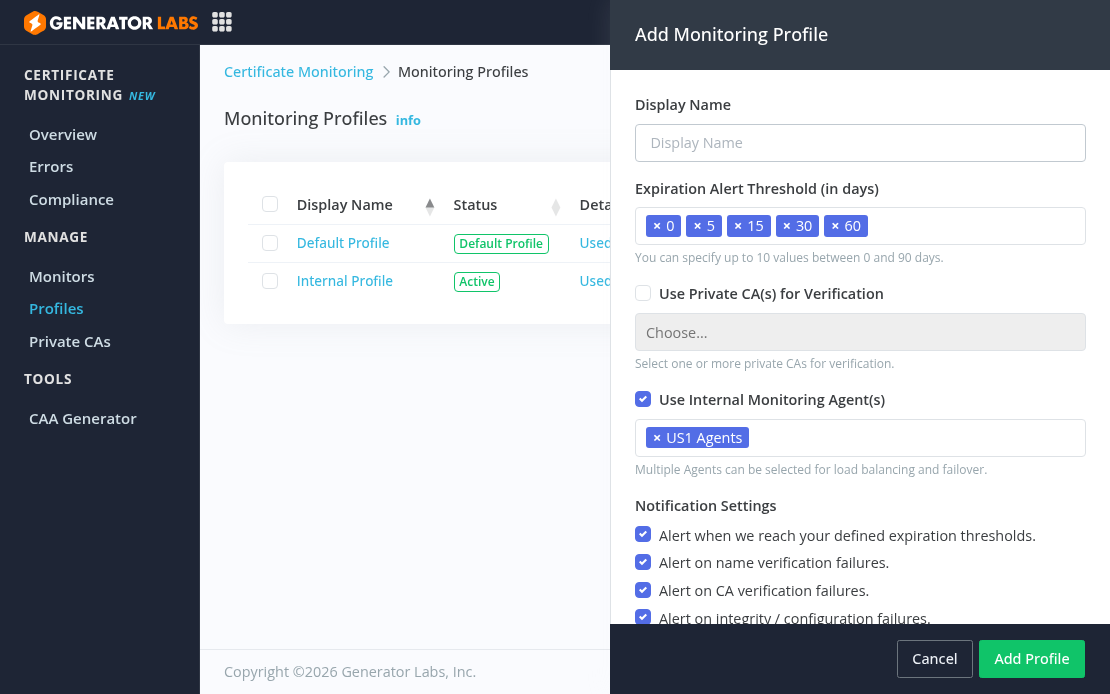
Monitoring profiles let you define reusable alert configurations across multiple monitors. Set custom expiration alert windows (5, 15, 30, 60 days, or any combination you need), choose which failure types trigger alerts, and assign private CAs or internal monitoring agents. One profile can cover dozens of monitors.

Generator Labs Certificate Monitoring add profile dialog

Certificate Monitoring Pricing

Certificate monitoring is priced at $0.01 per host per day, with no fixed tiers. You pay for what you monitor and can add or remove domains at any time.

Who It Is For

  • Email service providers and hosting companies monitoring large IP ranges
  • IT and security teams who need immediate notification when a host gets listed
  • Organizations managing many domains who need certificate expiry visibility without manual tracking
  • Developers who want API access to monitoring data for automation or integration

Get Started

Generator Labs offers continuous blacklist monitoring and certificate monitoring with solid alert coverage and a complete API. The free tier is a real free tier. Sign up at portal.generatorlabs.com to get started, no credit card required.

How Do RBLs Affect Me? (Part 3)

Originally posted on Generator Labs

In Part 1 and Part 2 of our series, I talked about what RBLs are, how they work, and how RBLs are used by administrators to control the day-to-day onslaught of SPAM on their email systems. In this article I’m going to talk about how RBLs affect you, your business, and why you should care.

So Why Do I Care?

Getting listed on an RBL or URIBL is not uncommon- it happens.

  • Maybe you have a customer using your email platform that didn’t quite understand the rules against bulk email.
  • Maybe one of your employees downloaded some virus infested software that started sending SPAM to all the contacts in their email client.
  • Maybe your email administrator made a mistake when configuring your email system, and opened you up as an open relay.
  • Maybe the WordPress or Drupal installation on your website was compromised, and injected with phishing code.

We all do our best to ensure that these types of errors aren’t the norm, but human error happens.

As a mail recipient, RBLs protect you from these issues by rejecting these messages before they land in your inbox. As a mail sender, RBLs protect others FROM your issues- and limit your overall liability, by reducing the number of messages delivered.

By listing compromised mail servers and website domains, and using these RBLs and URIBLs in our mail systems, we effectively limit the spread of SPAM and phishing websites, which is good for everybody.

Sounds Great- What’s the Catch?

Once you’re listed- as the name indicates- you’re “black-holed”- much of your email won’t be reaching its destination, and traffic to your websites could be limited.

If your business relies on email communication- either as a tool, or a product- then the longer you’re listed, the worst it is for your bottom line, and your reputation. It looks really bad if your customers email you, and get a bounce message indicating that your email system has been blocked.

The sooner you know there is an issue, the sooner the issue can be resolved, and the sooner you can request delisting from the RBLs in question.

Generator Labs

Generator Labs provides a fully automated RBL monitoring service, which checks your IP addresses and website domains, against a customizable list of the top DNSBLs, and will alert you immediately if your system is listed.

Don’t wait days or weeks to find out that your email hasn’t been reaching your customers- click here to find out more!