Over the last while I have moved everything I run on AWS to Graviton, the ARM CPUs AWS designs in house: the EC2 instances behind my services and the ECS containers that make up most of the actual workload. The short version is that it was worth it, the bill went down, and almost nothing about how I write or run code had to change. The longer version has a few sharp edges worth writing down, plus some genuinely interesting silicon arriving now in Graviton5.
Why ARM in the Cloud
The pitch is not “ARM is faster,” it is price/performance. For the same dollar you generally get more useful work out of a Graviton instance than the equivalent Intel or AMD one, and AWS prices the instances lower on top of that. Set expectations correctly, though: a single Graviton core will not smoke a top-bin x86 core on a single-threaded benchmark. The win shows up across a fleet of web servers, API workers, queue consumers, and databases: more cores per dollar and steady throughput under real concurrent load. If you are chasing the lowest latency on one hot thread, measure first.
ARM vs Intel vs AMD in Practice
Graviton is my default: best price/performance for general compute, web tiers, microservices, and most databases, at the lowest cost and power.
AMD is the value x86 option when something genuinely needs x86 but not Intel specifically.
Intel is a deliberate choice for AVX-512, Intel-specific acceleration, or vendors that only certify on Intel. It is the priciest of the three.
What actually decides it is rarely the chip and almost always the software. If everything you run is open source or built from your own source, ARM is a non issue. The moment a proprietary, x86 only binary shows up, that workload stays on x86 until the vendor ships an ARM build. So the real question per service is not “is ARM fast enough,” it is “does every binary in this container have an arm64 version.”
What Actually Bit Me
None of these were dealbreakers, but I wish I had batched them up front instead of finding them one service at a time.
The first one is the biggest mindset shift: your images must be multi-arch. Your base images, every layer, and your own build all need linux/arm64. I moved to docker buildx and publish multi-arch manifests so one tag resolves correctly wherever it runs:
Then ECS has to be told which architecture to use. The task definition’s runtimePlatform defaults to x86, so set it to ARM64 and run on Graviton capacity or Fargate:
When a service misbehaves after the switch, the first thing I check is whether the published tag actually contains both architectures. This one-liner saves a lot of guessing:
docker buildx imagetools inspect myrepo/myservice:latest
# look for linux/amd64 and linux/arm64 in the platform list
The rest are smaller traps worth knowing up front:
Emulated CI is slow. Building arm64 on an x86 runner means QEMU, which is painful for anything compiled. You no longer have to: GitHub-hosted native arm64 runners are generally available, free for public repositories and now offered for private ones too, so the pipeline builds on real ARM hardware instead of emulating it.
Native dependencies are the long tail. Interpreted code moves for free; compiled extensions (native npm modules, Python wheels, cgo, old vendored binaries) each need an arm64 build.
Check your sidecars. Logging, metrics, and security agents need arm64 images too. The mainstream ones have them, but a sidecar that silently fails to start will ruin your afternoon.
Managed services are the easy win. RDS, ElastiCache, and Lambda offer Graviton with no code change. Start there to build confidence.
Graviton5: What Changed
While I was mid migration, AWS moved the goalposts. The lineage shows the trajectory:
Gen
Cores
Microarch
ISA
Clock
Memory
Graviton2
64
Neoverse N1
Armv8.2-A
2.5 GHz
DDR4
Graviton3
64
Neoverse V1
Armv8.4-A
2.6 GHz
DDR5-4800
Graviton4
96
Neoverse V2
Armv9.0-A
2.8 GHz
DDR5-5600
Graviton5
192
Neoverse V3
Armv9.2-A
3.3 GHz
DDR5-8800
Graviton5, announced in December 2025 with M9g instances reaching general availability in mid 2026, is a bigger step than the version bump suggests. It doubles Graviton4 to 192 Neoverse V3 cores, built on a 3nm process as four chiplets of 48 cores each with up to ~420 GB/s between chiplets. It carries 192 MB of L3 cache (around five times the prior generation), 2 MB of L2 per core, DDR5-8800, and PCIe Gen6. It also ships a new Nitro Isolation Engine, which AWS describes as a formally verified hypervisor: the VM isolation property is mathematically proven, not just tested.
AWS quotes roughly 25% better compute than Graviton4 per core, with up to ~35% on web apps, up to ~35% on ML inference, and ~30% on databases from improved branch prediction. Take vendor percentages with the usual grain of salt and benchmark your own workload, but the architecture behind them is real. For densely packed container fleets the per core number matters less than doubling the cores while growing cache and memory bandwidth. The general purpose M9g and M9gd are out now; the compute optimized C9g and memory optimized R9g are the variants I am waiting on, since most of my fleet maps to those shapes.
Is It Worth It
For me, clearly yes. If your stack is containers and managed services built from source or mainstream images, the migration is mostly mechanical: make images multi-arch, set the architecture on your tasks, fix the native dependency stragglers. Start with managed services for an easy win, then move containers one service at a time so you can roll back cleanly. The one piece of advice I would give my past self: audit dependencies and sidecars for arm64 support before flipping anything. Ninety percent of the work is trivial. The other ten percent is one unmaintained binary you forgot about, and it is much nicer to find it on a spreadsheet than in a failing deployment.
I’ve spent a lot of time in my career building and scaling out APIs, and over the years I’ve noticed something: most of what makes an API scale is not what people write about. The standard advice stops at “put a load balancer in front and add more web servers.” That is the easy part. The web tier is stateless, so you can buy your way out of it. The interesting problems sit behind it, in the database, the cache, and the way clients talk to you.
So I wrote down the less-obvious things, the decisions that decide whether an API absorbs a traffic spike or falls over at the first one. None of it is exotic. It is just the stuff that tends to get learned the hard way.
Put Rate Limiting at the Front Door
Rate limiting is almost always an afterthought. The API works, traffic is light, and capping requests feels like next quarter’s problem. Then one bad client or a runaway retry loop sends ten thousand requests a minute and takes the whole service down. It belongs at the very front, not the end: a request you reject at the edge costs nothing, no query, no cache lookup, no compute. Use a token bucket keyed per client, which absorbs short bursts and settles to a steady rate:
# token bucket, one per client, refilled at a steady rate
b = buckets[client_id]
b.refill(rate = 100/min)
if b.tokens < 1 {
    return 429, ratelimit_headers(b)   # reject at the edge, cheaply
}
b.tokens -= 1
What people skip is telling the client what the limits are. A bare 429 leaves every client guessing, and a guessing client retries badly. The IETF is standardizing this in RateLimit header fields for HTTP, replacing the dozen proprietary X-RateLimit-* variants with one standard set:
HTTP/1.1 429 Too Many Requests
RateLimit-Limit: 100
RateLimit-Remaining: 0
RateLimit-Reset: 42
Retry-After: 42
It also defines a combined RateLimit field and a RateLimit-Policy that advertises the quota up front. The draft comes from the Italian government, Red Hat, and Microsoft rather than a single vendor, and providers like Cloudflare already emit these. Send them, and well-behaved clients throttle themselves, which is load you never have to shed by force.
Retries Are the Other Half of Rate Limiting
Rate limiting controls what comes in. Retries are what happens when you say no, and they can hurt more than the original traffic. The classic failure: you get slow, clients time out, every client retries at once, and that traffic lands on a system already underwater. It is called a retry storm, and it is one of the most common ways an API takes itself down.
Retries need exponential backoff with jitter. Backoff makes each attempt wait longer than the last; jitter adds randomness so a thousand clients that failed at the same instant do not all retry at the same instant and collide again on the next wave. AWS has a good write-up on why jitter matters. Cap the attempts as well, so a failing dependency is not hammered forever:
for attempt in 0..maxRetries {
    resp = send(request)
    if resp.ok or not retryable(resp) {
        return resp
    }
    delay = min(cap, base * 2**attempt)
    sleep(random(0, delay))            # full jitter desynchronizes clients
}
return last_error                      # give up; do not retry past the budget
The other question is whether a retry is even safe. A retried write must not charge a card or create a record twice. Idempotency keys solve this: the client sends a unique key, you store the result against it, and a repeat of that key returns the stored result instead of redoing the work.
POST /v1/charges
Idempotency-Key: 8f14e45f-ceea-467a-9f1a-1b2c3d4e5f60

# server side: claim the key atomically BEFORE doing any work
key = request.header["Idempotency-Key"]
if not store.claim(key) {              # insert-if-absent; false if it already exists
    return store.await_result(key)     # another copy owns it: wait for or replay its result
}
resp = process(request)
store.put(key, resp, ttl=24h)          # record the result for future replays
return resp
The claim has to be atomic. A plain check-then-write lets two concurrent retries both miss and both run, which defeats the whole point; an insert guarded by a unique constraint, or a Redis SETNX, makes exactly one caller the owner; the rest wait for or replay its result. Stripe wrote the canonical description. Build it in early, because retrofitting idempotency onto live write endpoints is painful.
Caching Is a Stack, Not a Setting
Everyone caches. What gets missed is that caching happens at several independent layers, and the biggest win is often the one you ignored:
HTTP caching via Cache-Control, so browsers and intermediaries reuse a response without asking again.
CDN or edge caching, serving one response to many clients from a nearby location.
Application caching in memory or Redis, for computed values and query results.
Database caching, the query-plan and buffer caches the database keeps on its own.
The application layer usually follows the cache-aside pattern: check the cache, fall back to the source on a miss, then populate it for next time. Store a sentinel for empty results too, or a lookup that finds nothing falls through to the database on every call.
# cache-aside: nil means a real miss, not a cached "not found"
v = cache.get(key)
if v == nil {
    v = db.query(key)
    cache.set(key, v ?? NEGATIVE, ttl = 10s)   # cache empties too, as a sentinel
}
return (v == NEGATIVE) ? null : v
The lesson that changed how I think about caching is that even a tiny TTL pays off. You do not need an hour. On an endpoint hit a hundred times a second, a ten-second cache means you compute the real answer once and serve it from cache about a thousand times:
The data is ten seconds stale, which nobody notices on most read paths, and you have cut the load behind the cache by three orders of magnitude. Short TTLs are the cheapest scaling lever there is, and they get left on the table because ten seconds feels too short to bother with. The stale-while-revalidate hint, from RFC 5861, goes further still: a cache serves the stale copy instantly while it refreshes in the background, so no client ever waits on the miss.
Not Every Response Needs a Body
If a client already holds a copy that has not changed, the cheapest possible response is to say exactly that. You attach an ETag, a short version fingerprint, to the response; the client sends it back on its next request, and if nothing changed you return a 304 with no body:
GET /v1/widgets/42
If-None-Match: "a1b2c3d4"

HTTP/1.1 304 Not Modified
MDN has the details. That saves bandwidth, and often computation too: if you can decide the ETag is unchanged without building the full response, you skip the expensive work entirely.
Stampedes Bypass Your Cache
This is the one that bites people, because it defeats the cache you just built, and the reason is hiding in that cache-aside snippet: the cache is only written at the end, after the query returns. That is fine until traffic is concurrent.
Picture a popular key with a ten-second TTL. It expires, and in the window between the first request missing and that same request finishing its query, every other request that arrives also finds the cache empty, also misses, and also queries the database, because nobody has populated it yet. Under load that window holds hundreds of requests, and they all run the same query at once. The cache that was meant to protect the database has aimed a thundering herd straight at it. In the logs it looks like this:
12:00:09.998  hit   key=widgets:top
12:00:10.001  MISS  key=widgets:top  -> db query 1422ms
12:00:10.001  MISS  key=widgets:top  -> db query 1455ms
12:00:10.002  MISS  key=widgets:top  -> db query 1480ms
12:00:10.002  MISS  key=widgets:top  -> db query 1503ms
   ... 900 more identical queries in the same 4ms ...
The more popular the key, the bigger the herd, so a stampede hits your hottest paths hardest. Wikipedia calls it a cache stampede. The fix is single-flight, or request coalescing: when many callers need the same uncached value, one does the work and the rest wait and share its result. Go ships it as golang.org/x/sync/singleflight:
v, _, _ := g.Do("widgets:top", func() (any, error) {
    return loadFromDB()      // runs once; the herd shares its result
})
One query runs instead of a thousand. But single-flight only coalesces within one process. Across a fleet of servers each one still rebuilds the key once, so a popular key gives you one stampede per server. To collapse the rebuild across the whole fleet, take a short distributed lock in Redis with SET NX and let the single winner rebuild while everyone else serves the previous value:
# only ONE caller across the fleet rebuilds the key
ok = redis.set("lock:" + key, token, NX=true, EX=5)
if ok {                                # we won the lock
    v = loadFromDB()
    cache.set(key, v, ttl=10s)
    redis.del("lock:" + key)           # release (verify token first in real code)
} else {                               # someone else is already rebuilding
    v = cache.get_stale(key)           # serve the slightly-stale copy, do not pile on
}
SET key value NX means set the key only if it does not already exist. It is atomic, so it succeeds for exactly one caller and fails for every other, which is precisely the property a lock needs. The EX 5 gives the lock a five-second expiry, so a holder that crashes mid-rebuild cannot wedge the key shut forever. The winner does the one rebuild; everyone else sees the lock is taken and serves the old value instead of hammering the database. Single-flight handles the in-process herd, the Redis lock handles the cross-fleet herd, and they compose.
Two cheaper measures help on top: jitter your TTLs so keys created together do not all expire together, and use probabilistic early expiration so a hot key refreshes just before it goes cold. Behind a CDN the same idea is origin shield or tiered caching, collapsing many edge misses into a single origin request; CloudFront calls it Origin Shield. Turn it on.
Send Reads to Read Replicas
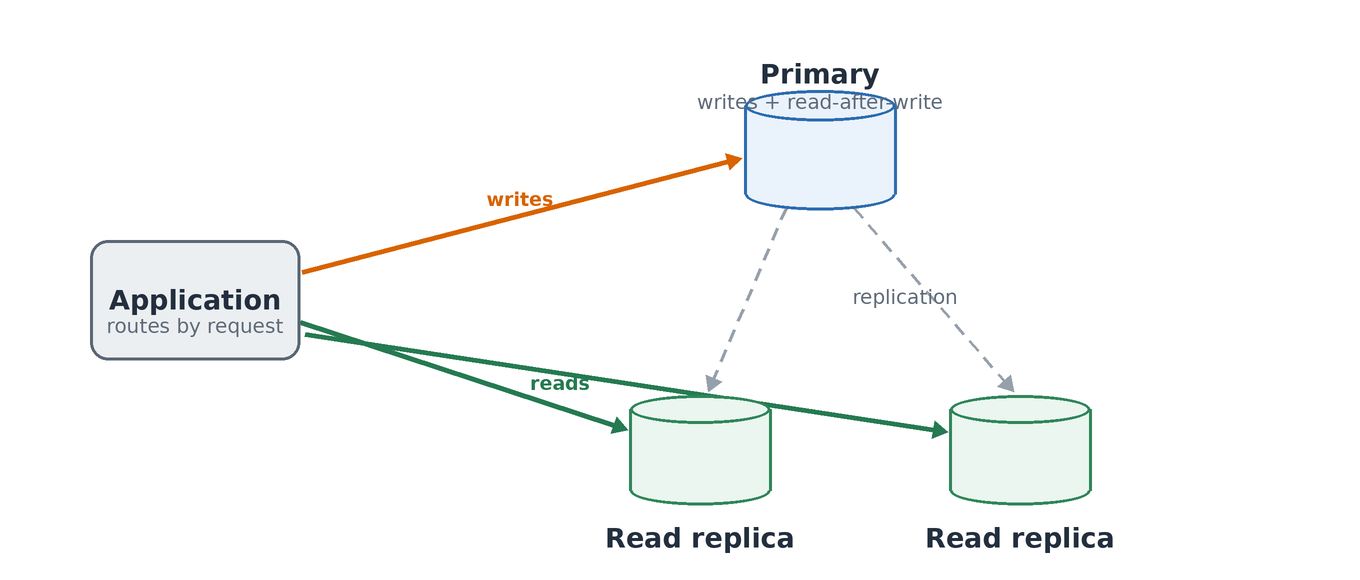
Most APIs are read-heavy, and mine is no exception: reads dwarf writes. Yet by default they all go to the same primary that handles writes, and that primary becomes your bottleneck long before anything else does. Split them: the primary takes writes, one or more replicas take reads, and you route each request to the right place:
func dbFor(req) Conn {
    if req.Method != "GET" {
        return primary              // all writes go to the primary
    }
    if req.Path == "/v1/orders/checkout" {
        return primary              // read-after-write must be current
    }
    return replicas.next()          // round-robin across read replicas
}
The catch is replication lag. A replica trails the primary by a fraction of a second, so a client that writes and immediately reads its own write can see stale data. Route those read-after-write paths to the primary, as the checkout case does, and send everything else to the replicas.
Writes go to the primary; reads fan out to the replicas. Read-after-write paths stay on the primary, because replication lags by a fraction of a second.
Connection Pooling Is the Hidden Ceiling
Read replicas lead straight to the least glamorous and most important item here. A database connection is not free. On most engines each one is a server-side process or thread with real memory behind it, and there is a hard limit on how many can exist at once. If every worker opens its own, you hit that ceiling long before you run out of CPU or memory, and the database refuses new connections while your servers sit mostly idle.
The fix is a connection pooler between the application and the database, multiplexing many client connections onto a few real ones. Every engine has the option: PgBouncer or pgpool for Postgres, ProxySQL for MySQL, an in-process pool in most drivers and ORMs. PgBouncer makes a good example, because the detail that matters is its pooling mode:
In transaction mode a client holds a real connection only for the length of a single transaction, so the twenty above can serve a thousand clients. The mode is the whole game: session pooling pins a connection to a client for its entire session and scales far worse. The one catch is that anything relying on session state, like prepared statements or advisory locks, needs care or a different mode.
Pooling and the read/write split from the last section are separate jobs, but they meet here: you usually run one pool per endpoint, one against the primary and one against the replicas, and the application picks the pool the same way the router earlier picked the database. Some proxies will do that routing for you. ProxySQL and pgpool-II can inspect a query and send writes to the primary and reads to a replica, and RDS Proxy offers read-only endpoints for Aurora. It is convenient, but I keep the routing in the application, because a proxy guessing read versus write still has to get transactions and read-after-write right, and that is exactly where it tends to surprise you.
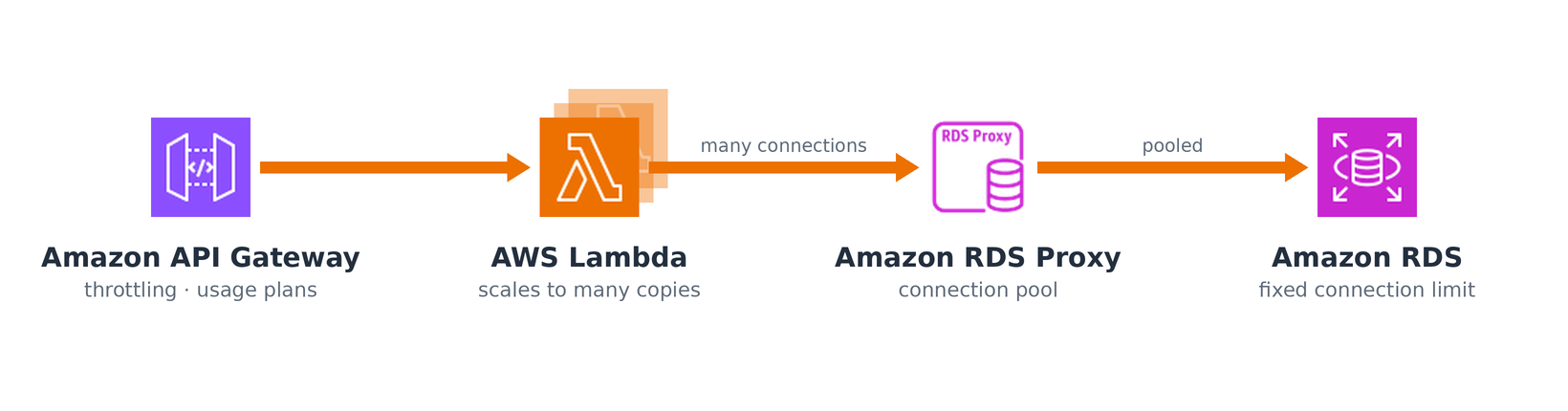
This gets dramatically worse with serverless, a perfect segue to the next section. If every function instance opens its own connection, a spike that starts hundreds of instances opens hundreds of connections at once, and the database refuses them. On AWS the managed answer is RDS Proxy. Whatever the engine, the rule is the same: the connection count is a hard ceiling, and pooling is how you raise it.
The OFFSET Pagination Cliff
This one stays invisible until your tables get big. LIMIT/OFFSET pagination works perfectly in testing, but OFFSET does not skip rows for free: to reach the rows after an offset, the database has to generate every row before it and throw them away. The first page is instant. By the five-thousandth, it is walking past a hundred thousand rows and discarding them on every request, and it only gets slower the deeper anyone pages. Use keyset, or cursor, pagination instead: remember the sort key of the last row you returned and ask for the rows after it:
select id, name from widgets
where id > :last_id
order by id
limit 20;
With an index on the sort column, every page costs the same at any depth. It also stays correct when rows are inserted mid-page, where OFFSET silently skips or duplicates. The one thing you give up is jumping to an arbitrary page number, which most APIs do not actually need.
One catch: the sort key has to be unique. If you page by something that is not, like a timestamp, order by a unique tiebreaker as well, such as (created_at, id), and compare the pair; otherwise two rows that share a value can straddle a page boundary and get skipped or repeated.
Watch for Hot Keys
Even with replicas and caching, a single key can be popular enough that the one node holding it becomes a bottleneck while everything else sits idle: a celebrity account, a viral item, one enormous customer. Horizontal scaling does not help, because you cannot shard a single key across machines. Cache that value locally in each process so it never touches the shared store, or, for a write hot spot, add a small random suffix to the key so the load spreads across nodes:
# pin a hot value in-process so it never hits the shared store
if local.fresh(key) {
    return local.get(key)              # zero network, zero shared load
}
v = redis.get(key)
local.set(key, v, ttl = 1s)            # a one-second local cache is enough
return v
The trap is that average load can look perfectly healthy while one key is on fire, so watch your hottest keys specifically, not just the average.
Move Work to Write-Time
The cheapest request is one whose answer was computed before it arrived. A surprising amount of read load is the same aggregation or join, recomputed on every call, when it could have been computed once, when the data changed, and simply read back. This is the same instinct as caching, moved one step earlier: do the work on the write, not on the read.
The bluntest form is a denormalized counter or rollup maintained on write. Instead of a count(*) across a large table on every read, keep the number in a column and update it in the same transaction as the write:
-- on write: keep the rollup current
update widgets set view_count = view_count + 1 where id = :id;

-- on read: no aggregation, just a column
select view_count from widgets where id = :id;
For heavier aggregates, a materialized view precomputes the result and stores it, so the read is a plain select against an indexed table instead of a large scan. You refresh it on a schedule or when the inputs change:
create materialized view top_widgets as
    select widget_id, count(*) as hits
    from views
    group by widget_id;

refresh materialized view concurrently top_widgets;   -- on a schedule
The fullest form is a precomputed read model: when a write lands, assemble the exact shape the read endpoint serves and store it, so the endpoint becomes a key lookup rather than a query. The tradeoff is real, though. You do more work on writes, the read can lag the truth by a little, and you now have a thing to keep in sync. For a read-heavy API that is almost always the right trade, because writes are rare and reads are constant, so you are moving work off the path that runs a thousand times as often.
Do Not Let One Slow Dependency Sink Everything
Scaling is also about failing well. When one dependency slows down, the default is for requests to pile up waiting on it, each holding a thread and a connection, until the whole service is exhausted and even unrelated endpoints stop responding. One slow thing takes down everything. Three patterns prevent it: load shedding, rejecting some requests when you are over capacity, because a fast 503 beats a slow timeout; circuit breakers, which stop calling a clearly-failing dependency and fail fast; and bulkheads, which isolate the connection or thread pool per dependency so one cannot starve the others. Load shedding can be as blunt as a concurrency cap at the front of the handler:
# a bounded semaphore acquires-or-fails atomically: no check-then-act race
if not slots.try_acquire() {        # slots = maxInflight permits
    w.Header().Set("Retry-After", "1")
    return 503, "over capacity"     // shed early, protect the rest
}
defer slots.release()
A circuit breaker applies the same idea to a downstream dependency: once it is clearly failing, stop calling it and return right away instead of making every request wait out the timeout. The piece people forget is the way back: after a cooldown the breaker goes half-open and lets a single probe through, which closes it on success or re-opens it on failure. Without that, it stays open forever.
if breaker.state == OPEN {
    if not breaker.cooldown_elapsed() {
        return fallback()              # fail fast while the breaker is open
    }
    breaker.state = HALF_OPEN          # cooldown passed: let one probe through
}
resp, err = call(dependency)
breaker.record(err)                    # a clean probe closes it; a failure re-opens
return resp
And a lot of work does not belong in the request at all. If a client asks for something slow, accept it, return 202 Accepted with a URL to poll, and hand the work to a queue that background workers drain at their own pace:
HTTP/1.1 202 Accepted
Location: /v1/jobs/abc123
That keeps the request path fast and lets the slow work scale independently of the API that accepts it.
Scaling With Managed Pieces
You do not have to build all of this yourself. On AWS, API Gateway and Lambda bundle a lot of it together, and the pair is worth understanding even if you never deploy on it, because it is a good illustration of what sensible defaults look like.
API Gateway throttles at the edge, Lambda scales to many copies, and RDS Proxy pools their connections down to a set the database can actually handle.
API Gateway sits in front as the door. It gives you throttling, per-client usage plans, response caching, and request validation at the edge, before a bad request ever reaches your code. A usage plan is the same token bucket from the first section, plus a burst ceiling and a monthly quota, attached to an API key and handed to you as configuration instead of code you write and maintain. Behind it, Lambda runs your handler and scales the compute automatically, spinning up copies to match concurrency, with provisioned concurrency to keep a pool warm if cold starts hurt.
The trap is the one from the last section: Lambda scales by running many isolated copies of your function, and if each copy opens its own database connection, a spike turns into a connection storm, which is exactly why RDS Proxy exists. But that connection problem hints at a larger truth: not every API belongs in Lambda in the first place.
Lambda is a great fit when traffic is spiky or has a low baseline, the kind of workload where you would otherwise pay for servers that sit idle most of the time. A webhook receiver that fires a few times a minute, a payment or Slack callback, an internal endpoint hit occasionally, a scheduled job, a public API whose traffic swings between near-zero and sudden bursts: in all of those you pay only for what actually runs, and the automatic scaling does precisely what you want.
It is a poor fit in a few specific cases, and they are worth knowing before you commit to it:
Sustained high throughput. At a steady few thousand requests a second, per-invocation pricing costs far more than a couple of always-on containers, and you get none of the idle-time savings that justify Lambda in the first place. A busy search or feed API is cheaper and more predictable running on containers.
Tight latency budgets. A cold start adds tens to hundreds of milliseconds. If your p99 target is 50ms, a cold start blows straight through it, and buying enough provisioned concurrency to avoid that is just paying for warm servers with extra steps.
Long-running or streaming requests. API Gateway caps a synchronous integration at 29 seconds, with no exceptions. A long report, a large file download, a slow upstream call, or a server-sent-events stream simply does not fit. That work belongs on a normal server, or behind the 202-and-a-queue pattern from earlier.
Heavy shared state. Each invocation is isolated, so the in-process hot-key cache from earlier does not survive between requests, and anything that wants a large warm local cache or a long-lived connection fights the execution model the whole way.
The rule I actually use: reach for Lambda when traffic is bursty and the work is short and self-contained, and reach for plain containers behind a load balancer when traffic is steady, latency-sensitive, or long-running. The underlying pattern outlives the vendor either way. Elastic compute in front of a database with a fixed connection limit needs a pooler between the two, or it will scale right past what the database can take.
The Thread Running Through All of It
If there is one idea connecting all of this, it is that scaling an API is mostly about not doing work. Cache the answer so you do not compute it twice. Coalesce duplicate requests so one query serves a thousand callers. Send reads to replicas so the primary is free for writes. Shed or defer the load you cannot handle right now. Reject early what you were going to reject anyway. Adding servers is the part everyone talks about, because it is the part you can buy. These are the things that decide whether those servers spend their time on real work, or on work you could have avoided.