Almost every AI infrastructure bet I see rests on two assumptions: that the best models keep getting meaningfully better, and that you keep renting them from three or four companies. Both are weaker than they look, and I think they break sooner than the roadmaps imply. Here’s the chain of reasoning, in the order I expect it to play out.
The Frontier Is Getting Crowded From Below
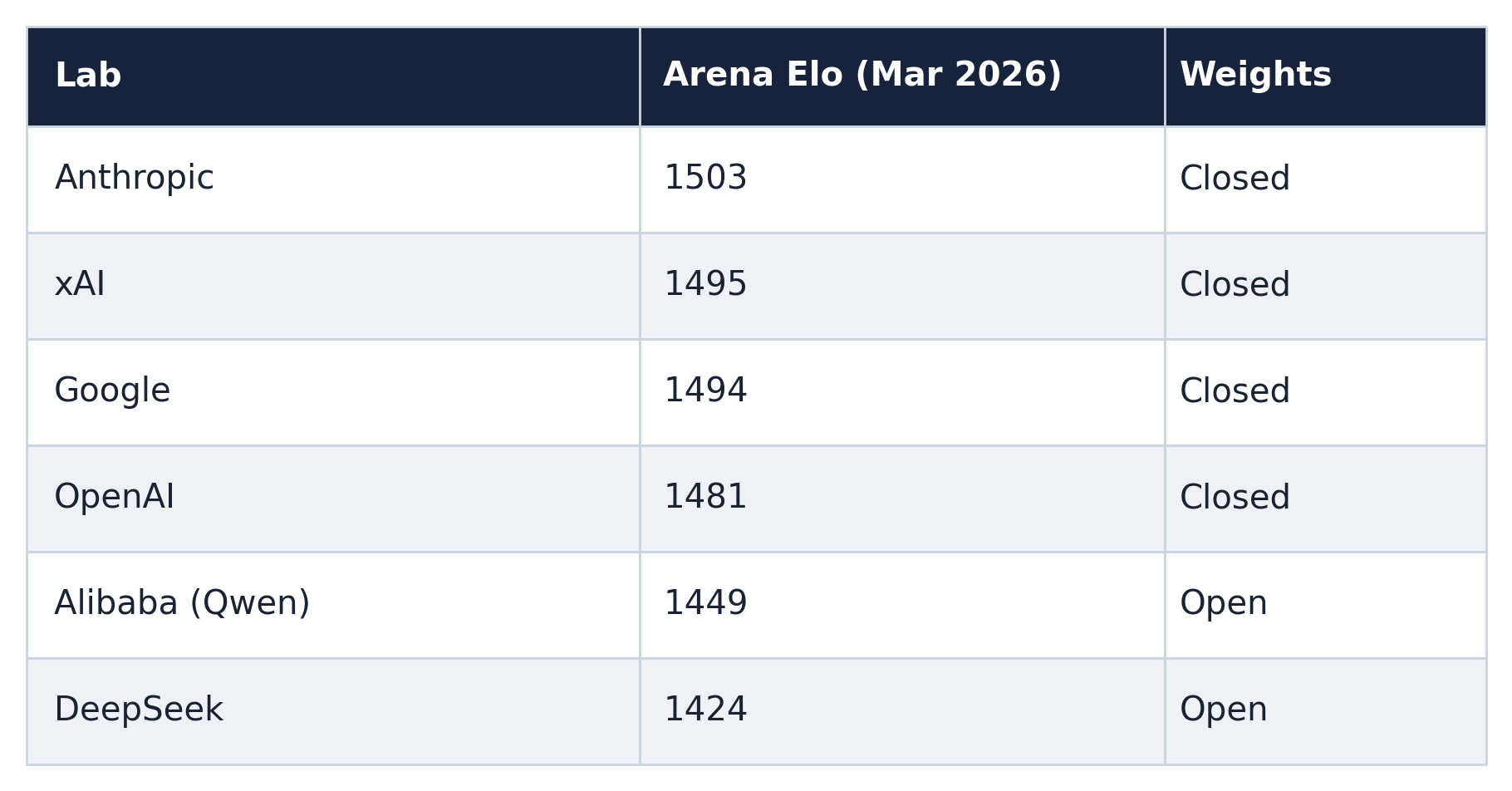
The distance between the best closed model and the best open one is now measured in months. Epoch AI puts the lag at roughly four months, about one point release, and Stanford’s 2026 AI Index shows four of the top ten public Arena models are now open weight, clustered tight on Elo.
The Frontier Is Getting Crowded From Below
Alibaba’s Qwen3.8-Max matches the closed frontier on general knowledge in its own benchmarks, and its open-weight sibling fits on a single GPU.

The frontier is still closed. But “a few percent behind and you can download the weights” is a different market than “only three companies can do this,” and everything below follows from that.
Nobody Needs a Frontier Model to Read a License Plate
Most production AI is narrow: translate a field, pull a total off an invoice, read a license plate, classify a ticket. Aiming a frontier model at those is like renting a rack to run cron. The cheaper purpose-tuned model that clears the bar at a fraction of the cost is the right call, so architectures are going multi-model: route each request to the cheapest model that passes, keep the expensive one for the genuinely hard reasoning.
The clearest signal of where this is headed is that Stripe just agreed to acquire OpenRouter (announced August 19, terms undisclosed, reported north of $7B by Bloomberg and TechCrunch), the router that sits in front of 400+ models and meters the tokens. When a payments company pays billions for the thing that routes and bills model calls, tokens have become a commodity you buy by the unit.
Commodities sold through a broker that shops for the cheapest passing option only get cheaper. If your business model assumes today’s token prices, plan for them falling by an order of magnitude.
The Plateau Comes Sooner Than the Roadmaps Say
Model progress will plateau, and given how fast the curve has moved, it will be sooner than you think. When the frontier stops jumping, the game stops being about the “smartest model” and becomes “same quality for the least money, power, and space,” which is a hardware question.
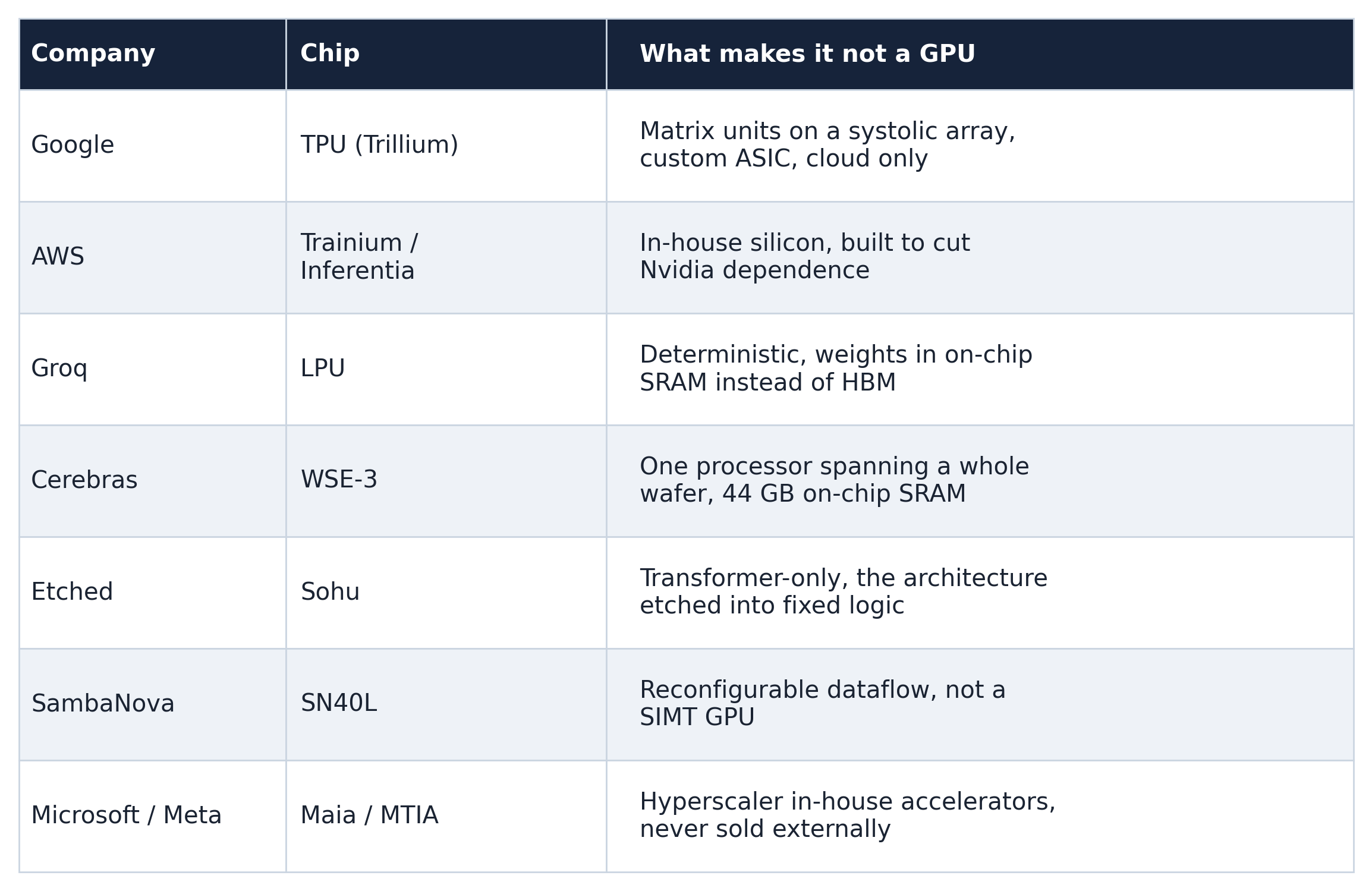
Today the answer is Nvidia H100 and H200 GPUs, and the challenge is two things: programmability (CUDA, a chip that runs whatever you invent next quarter) and networking (NVLink and InfiniBand lash thousands of GPUs into one fabric). But a frozen architecture is exactly what you burn into silicon, and plenty of companies are already betting on that.
Companies Already Building Fixed-Function AI Silicon
Etched is the purest bet: Sohu hard-codes the transformer into silicon and runs nothing else. Its throughput claims are marketing until someone benchmarks them independently, but the thesis holds. If the transformer is the architecture for the next decade, a chip that does only transformers wins on cost per token by a margin a flexible chip can’t answer.
We’ve seen this arc in crypto mining: CPU, then GPU, then ASIC, each stage wiping out the last. Litecoin’s Scrypt was deliberately designed to be “ASIC-resistant” to keep mining on GPUs. It didn’t work; Bitmain shipped the Antminer L3, a Scrypt ASIC, and the holdouts were finished.
AI is harder than a hash, so this runs slower and messier, and Nvidia’s networking outlasts its CUDA one. But the people betting GPUs stay central forever are standing where the Scrypt holdouts stood. It’s a question of when, and the when is closer than the capex suggests.
What Happens to the Buildings
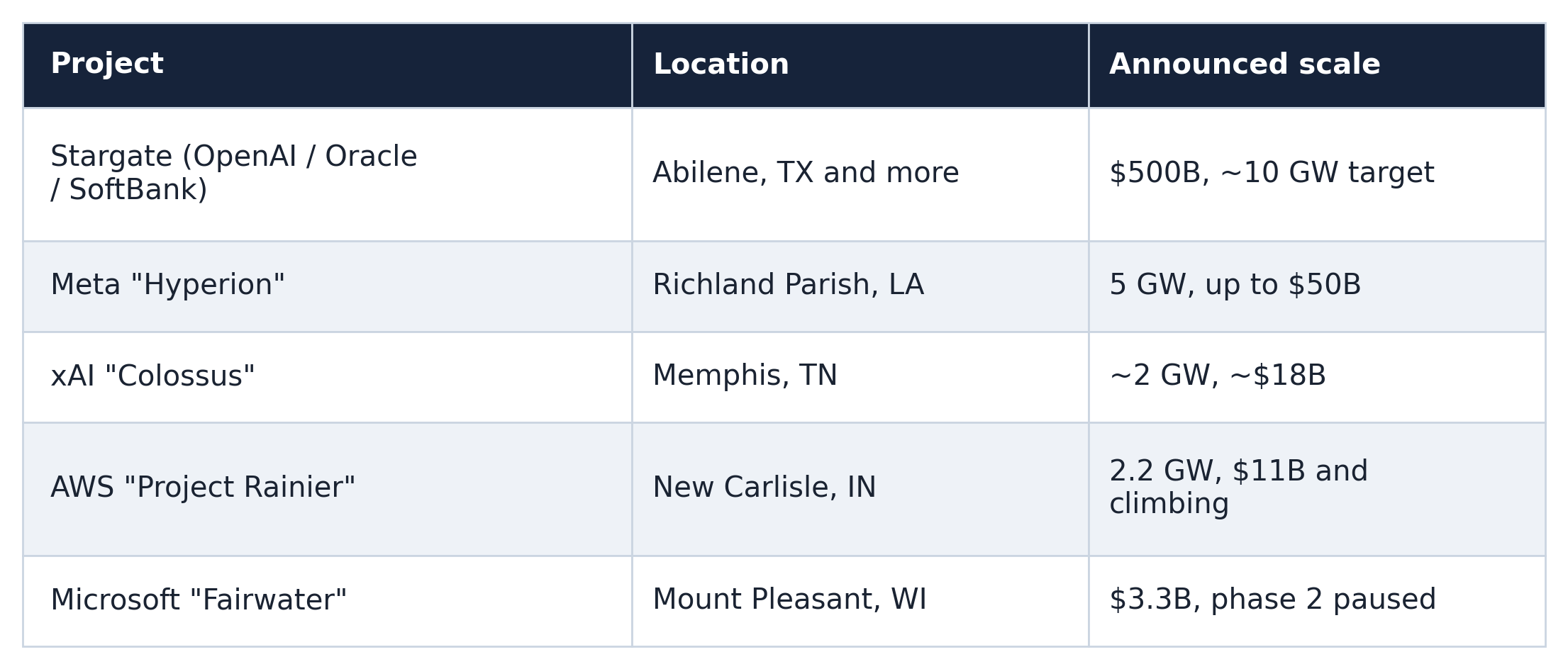
Meanwhile the industry is pouring concrete for a frontier that keeps advancing and a GPU that stays central.
What’s Been Announced (proposed data centers)
I don’t believe most of this gets built: Morgan Stanley pegs the data-center financing gap through 2028 at around $1.5T, Bain figures the industry is roughly $800B a year short on the revenue to fund it, and Satya Nadella has already said “there will be an overbuild.” Microsoft has been quietly canceling leases, which TD Cowen read as oversupply.
Now layer on the hardware shift. These campuses sit where power is cheap and land is empty, far from people, which is fine for training because training doesn’t care about latency. Inference does; it wants to sit near users.
So picture the end state: progress plateaus, the workload tilts to efficient inference on purpose-built silicon, and that inference wants a metro. What happens to a two-gigawatt training barn in rural Louisiana, built for GPUs doing a job that moved somewhere else? My honest guess is that some become the abandoned malls of this decade, stranded too far from anyone to repurpose. The ones near grid capacity, fiber, and people convert fine. The rest hold hardware that lost on cost per token, in a place nobody needs.
This is the ordinary shape of an infrastructure boom, and AI keeps working fine right through it. The first wave overbuilds general-purpose capacity chasing a moving frontier; the workload commoditizes and specializes; the hardware goes from flexible to fixed; and the winners are whoever got cost per useful token lowest, not whoever had the biggest model.
We ran this loop in mining, and in the fiber glut before it. Worth positioning for the back half now, while everyone else builds for the front.